
Introduction
The best B2B Marketing Strategies in 2026 help businesses attract qualified leads, build trust, and increase sales. By understanding their target audience and using the right marketing channels, companies can reach potential clients and develop long-term business relationships.
B2B marketing strategies to generate leads in 2026 are essential for businesses that want to attract potential customers, build relationships, and increase sales. Business-to-business (B2B) marketing focuses on promoting products or services to other businesses rather than individual consumers. Because business buyers often compare several providers before making a decision, companies need a clear marketing strategy to stand out.
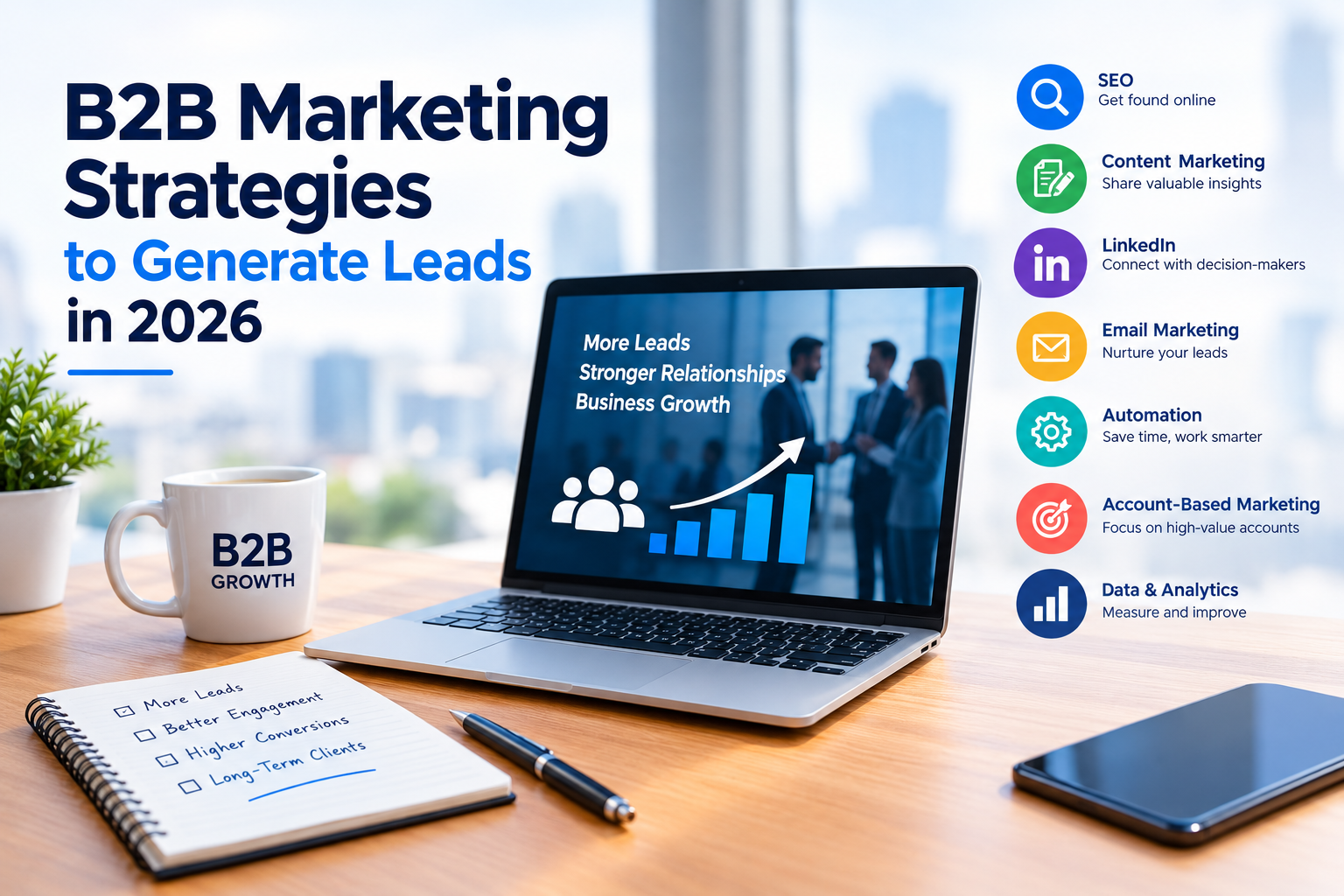
Modern B2B marketing combines content creation, search engine optimization (SEO), social media, email marketing, and data analysis. By understanding their target audience and providing useful information, businesses can attract qualified leads and turn potential customers into long-term clients.
1. Understand Your Target Audience
One of the most important B2B marketing strategies is understanding the businesses you want to reach. Before launching a campaign, identify your ideal customers, their industries, company sizes, budgets, and business challenges.
You should also understand who makes purchasing decisions. Depending on the product or service, this could include business owners, marketing managers, purchasing teams, or senior executives.
Creating an ideal customer profile helps businesses focus on prospects who are more likely to need their services. It also makes marketing messages more relevant and reduces wasted time and advertising costs.
2. Use Search Engine Optimization to Attract Leads
Search engine optimization helps businesses appear in search results when potential customers look for relevant products, services, or solutions. It is one of the most useful long-term B2B marketing strategies because it can attract people who are already searching for answers.
Start by researching keywords related to your industry and customer needs. Use relevant keywords naturally in page titles, headings, meta descriptions, and website content.
Publish helpful articles that answer common questions, compare solutions, and explain how your products solve business problems. For example, a company offering business software could publish a guide about choosing the right software for a growing company.
A well-optimized website should also load quickly, work on mobile devices, and make it easy for visitors to contact your business or request a demonstration.
For additional guidance, businesses can follow Google’s SEO Starter Guide to improve their website’s search visibility.
3. Create Valuable Content Marketing
Content marketing remains one of the most practical B2B Marketing Strategies because it educates potential clients and builds confidence in your business.
Content marketing helps businesses build trust by sharing useful information with potential customers. Instead of focusing only on selling, provide content that helps readers understand problems and make informed decisions.
Effective B2B content includes blog posts, industry reports, case studies, webinars, guides, and comparison articles. Each format serves a different purpose. Blog posts can attract visitors through search engines, while case studies demonstrate how a business has helped customers achieve results.
For better lead generation, offer a useful resource in exchange for contact details when appropriate. For example, visitors might download a business planning guide or industry report by submitting their email address.
Make sure the content delivers genuine value. Helpful information can encourage potential clients to return to your website and consider your services when they are ready to buy.
4. Use LinkedIn and Other Social Media Platforms
Social media allows B2B companies to connect with decision-makers, share expertise, and introduce their services to relevant audiences. LinkedIn is particularly useful for professional networking, industry discussions, and business-focused content.
Businesses can share educational posts, company updates, customer success stories, short videos, and links to useful articles. Employees can also contribute professional insights to help increase the company’s visibility.
Rather than posting promotional messages every day, focus on answering questions and joining relevant industry conversations. Paid social media campaigns can help reach specific job roles, industries, or company types.
Track which posts generate meaningful engagement, website visits, and qualified inquiries. This helps you understand what interests your audience and improve future campaigns.
Businesses can explore LinkedIn Marketing Solutions to learn about tools for reaching professional audiences.
5. Build an Effective Email Marketing Strategy
Combining email campaigns with other B2B Marketing Strategies helps businesses nurture leads and maintain communication with potential customers.
Email marketing remains a practical way to nurture potential customers and maintain relationships with existing contacts. It allows businesses to deliver relevant information directly to people who have agreed to receive communications.
Start by organizing your contact list according to industry, business needs, role, or stage in the buying process. Then create email campaigns that match each audience segment.
For example, new subscribers might receive an introductory guide, while prospects who have requested product information could receive a case study or invitation to a demonstration.
Keep emails clear, useful, and focused on one main action. Track open rates alongside clicks, replies, qualified leads, and conversions. Avoid purchasing contact lists, and follow applicable email marketing and data protection rules.
6. Use Account-Based Marketing for High-Value Clients
Account-based marketing (ABM) focuses on selected businesses that are especially valuable to your company. Rather than targeting a broad audience, marketing and sales teams work together to engage specific organizations and their decision-makers.
Begin by identifying companies that match your ideal customer profile. Research their business goals, challenges, industry developments, and potential needs.
Then create personalized campaigns using relevant content, targeted advertising, direct outreach, or tailored product demonstrations. For instance, a technology provider might prepare a case study that addresses the specific operational challenges of a target company.
ABM can be particularly useful for businesses selling high-value services or products with longer sales cycles. Its success depends on careful research, coordination, and consistent follow-up.
7. Improve Lead Generation with Data and Automation
Data helps businesses understand which marketing activities produce the best results. Customer relationship management (CRM) systems can organize contact information, track sales conversations, and show where leads are in the buying process.
Marketing automation can support follow-up emails, lead notifications, and campaign workflows. For example, when a prospect downloads a guide, the system can send relevant follow-up information and notify the sales team when the prospect requests a meeting.
Businesses can also use analytics to identify high-performing pages, traffic sources, and campaign messages. Artificial intelligence tools may help with research and content planning, but important insights should be checked for accuracy.
Use data responsibly, protect customer information, and ensure automated communication remains relevant rather than repetitive.
8. Measure and Improve Your Marketing Results
Successful B2B marketing requires regular performance measurement. Without clear metrics, it can be difficult to determine whether campaigns are generating valuable business opportunities.
Important metrics include:
- Lead conversion rate: The percentage of visitors or prospects who become leads.
- Cost per lead: The average amount spent to generate a lead.
- Qualified leads: Prospects who meet your agreed sales criteria.
- Customer acquisition cost: The cost of gaining a new customer.
- Marketing-generated pipeline: Sales opportunities created through marketing activities.
- Return on marketing investment: The financial return associated with marketing spending.
Review these metrics regularly to identify what works and what needs improvement. Test different headlines, calls to action, landing pages, and email messages. Focus on lead quality and business outcomes rather than website traffic alone.
Conclusion
B2B marketing strategies to generate leads in 2026 require a combination of audience research, SEO, valuable content, social media, email marketing, and data analysis. Businesses can improve their results by targeting the right companies, building trust, and making it easy for potential customers to take the next step.
Start with the strategies that best match your audience and budget, measure their performance, and improve them over time. With consistent effort and relevant communication, businesses can generate more qualified leads, build stronger client relationships, and support sustainable growth.
For more practical tips, explore our guide to Small Business Marketing Strategies to learn how businesses can attract customers and improve their marketing results.
For more updates, visit SHINBIR MARKETER