
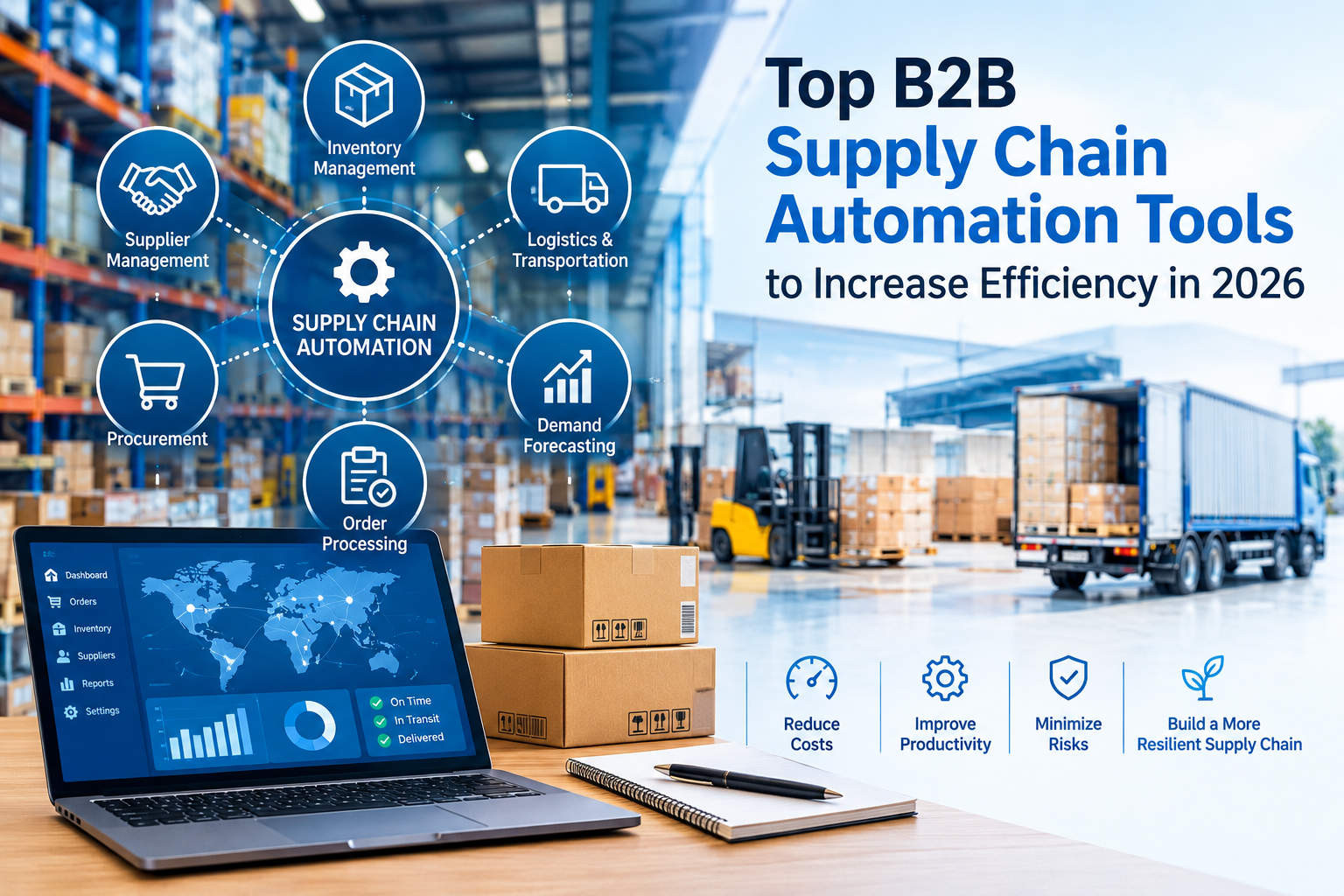
Supply chains are becoming more complex as businesses manage multiple suppliers, changing customer demands, and rising operational costs. In 2026, companies are increasingly using technology to improve purchasing, inventory management, transportation, and supplier communication. B2B Supply Chain Automation Tools help businesses automate repetitive tasks, reduce errors, and make better decisions using accurate operational data.
From manufacturers and wholesalers to distributors and retailers, companies can benefit from automated workflows that connect different parts of their supply chains. Choosing the right software can improve productivity, strengthen supplier relationships, and support sustainable business growth.
What Are B2B Supply Chain Automation Tools?
B2B Supply Chain Automation Tools are software solutions that automate business-to-business supply chain activities. These activities include procurement, purchase order processing, supplier management, demand forecasting, warehouse operations, and shipment tracking.
Instead of relying on spreadsheets, emails, and manual data entry, businesses can use connected systems to share information and manage operations more efficiently.
Many modern platforms also use artificial intelligence (AI), machine learning, and analytics to identify potential problems, predict demand, and improve planning. However, the right solution depends on the company’s size, industry, budget, and existing technology.
Top B2B Supply Chain Automation Tools in 2026
Several platforms offer features that help businesses automate supply chain processes. The following options serve different operational needs.
1. Microsoft Dynamics 365 Supply Chain Management
Microsoft Dynamics 365 Supply Chain Management helps businesses coordinate procurement, inventory, demand planning, warehouse operations, and order fulfillment. Its capabilities include analytics and AI-supported planning to help companies respond to changing demand and improve operational visibility.
Key benefits include:
- Improved demand forecasting and inventory planning.
- More efficient procurement and purchasing workflows.
- Better visibility into orders and warehouse operations.
- Integration with other Microsoft business applications.
This platform may suit medium-sized and large organizations that need connected supply chain processes. Businesses should evaluate implementation requirements and integration costs before choosing it.
2. Oracle Fusion Cloud Supply Chain Management
Oracle Supply Chain Management provides cloud-based capabilities for supply chain planning, procurement, inventory, manufacturing, and logistics.
Businesses can use its connected applications to coordinate operations, manage purchasing activities, and gain a clearer view of supply chain performance. Centralized information can help teams identify delays, assess demand changes, and make informed decisions.
Oracle may be suitable for organizations with complex operations across multiple departments or locations. Companies should consider their existing systems, employee training needs, and implementation resources when evaluating the platform.
3. SAP Supply Chain Management
SAP Supply Chain Management offers tools for planning, inventory management, manufacturing, logistics, and supply chain coordination.
Businesses can use SAP solutions to connect operational information and improve collaboration between purchasing, production, and distribution teams. Better coordination can help organizations manage materials, respond to disruptions, and improve delivery planning.
SAP is worth considering for manufacturers, distributors, and enterprises with complicated supply networks. However, the best solution depends on the company’s existing SAP environment and specific business requirements.
4. UiPath Supply Chain Automation
UiPath Supply Chain Automation focuses on automating repetitive tasks and coordinating workflows across existing business systems.
For example, automation can transfer information between applications, update records, route exceptions for approval, and support inventory-related decisions. UiPath can work alongside existing enterprise resource planning (ERP), warehouse management, and transportation systems rather than requiring businesses to replace every application.
Potential advantages include:
- Less repetitive administrative work.
- Reduced manual data entry.
- Faster processing of routine tasks.
- Improved consistency across workflows.
This option may suit businesses that want to automate specific processes without immediately replacing their entire supply chain software environment.
Key Benefits of Supply Chain Automation
1. Reduced Manual Work
Manual purchase orders, data entry, and approval processes can consume valuable employee time. Automation handles routine activities according to predefined rules, allowing staff to focus on supplier relationships, planning, and more complex problems.
Reducing repetitive work can also help businesses improve consistency and lower the risk of avoidable mistakes.
2. Better Inventory Management
Inventory problems can lead to lost sales, delayed orders, and unnecessary storage expenses. Automated inventory systems help businesses monitor stock levels, track product movement, and identify when replenishment may be necessary.
Demand forecasting can also help companies prepare for seasonal changes and unexpected increases in customer orders.
3. Improved Supplier Coordination
Supply chain automation makes it easier for purchasing teams to track purchase orders, monitor delivery schedules, and maintain supplier information.
When suppliers and internal teams have access to accurate information, businesses can identify potential delays earlier and coordinate solutions more effectively.
4. Faster Order Processing
Automated workflows can move orders through validation, approval, fulfillment, and invoicing with fewer manual steps.
This can reduce administrative delays and help businesses provide more reliable delivery estimates to customers.
5. Greater Supply Chain Visibility
Connected software gives managers a clearer picture of inventory, purchasing, supplier performance, and delivery progress.
With better visibility, businesses can respond more quickly to shortages, transportation delays, and unexpected changes in demand.
How to Choose the Right Automation Software
Before investing in B2B Supply Chain Automation Tools, businesses should identify their main operational challenges and compare available solutions.
Consider these important factors:
- Business requirements: Identify whether you need procurement, inventory, warehouse, or transportation automation.
- Integration: Check compatibility with existing ERP, accounting, and e-commerce systems.
- Scalability: Select software that can support future business growth.
- Ease of use: Consider employee training and the complexity of daily workflows.
- Security: Review access controls, data protection, and audit capabilities.
- Total cost: Include subscriptions, implementation, maintenance, and training.
It is also helpful to request product demonstrations and test the software against real business scenarios before making a final decision.
Best Practices for Implementing Supply Chain Automation
Successful implementation requires more than purchasing software. Businesses should begin by identifying time-consuming processes and setting measurable improvement goals.
Start with one area, such as purchase order processing or inventory tracking, before expanding automation across the organization. Clean and accurate data is essential because unreliable information can produce poor forecasts and incorrect decisions.
Employees should also receive appropriate training, while managers should regularly monitor performance indicators such as order accuracy, processing time, inventory turnover, and supplier delivery performance.
Finally, review automated workflows regularly to ensure they continue to support business goals and respond to changing operational needs.
Conclusion
The best B2B Supply Chain Automation Tools help businesses reduce manual work, improve inventory management, strengthen supplier coordination, and increase operational visibility. Microsoft Dynamics 365, Oracle, SAP, and UiPath offer different approaches to supply chain automation, so companies should compare their features and suitability carefully.
By choosing the right software, preparing accurate data, and implementing automation gradually, businesses can improve efficiency and build more resilient supply chains in 2026.
Businesses looking to improve their digital operations can also explore our guide to B2B E-Commerce Growth Strategies, which explains how smarter sourcing, digital buying processes, and scalable systems support long-term business growth.
For more updates, visit SHINBIR MARKETER



2 Responses