
Introduction
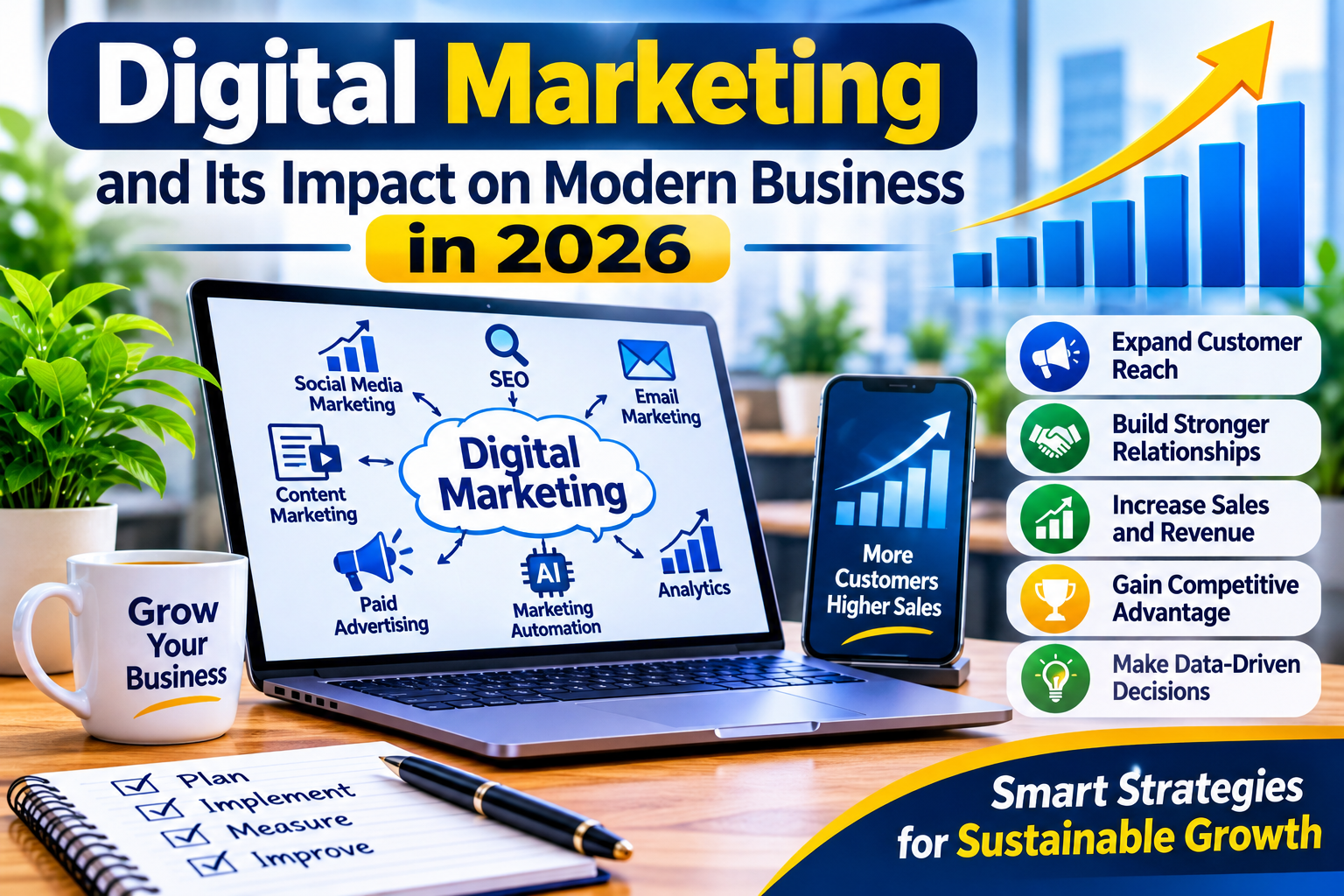
Digital Marketing and Its Impact on Modern Business in 2026 can be seen in how companies attract customers, promote products, build brand awareness, and compete in an increasingly connected marketplace. Businesses of different sizes now use digital channels to communicate with customers, understand their preferences, and create more convenient buying experiences.
Unlike traditional marketing methods that often rely on television, newspapers, radio, and printed advertisements, digital marketing uses online platforms and technologies to reach audiences. These include search engines, websites, social media, email, and online advertising.
However, digital marketing is more than simply promoting products on the internet. It helps businesses understand customer behavior, measure marketing performance, improve communication, and make informed decisions. This article explores the importance of digital marketing, its impact on modern businesses, the strategies companies use, and the challenges they should understand.
What Is Digital Marketing?
Digital marketing is the promotion of products, services, or brands through digital channels and online technologies. It allows businesses to communicate with potential customers through websites, search engines, social media platforms, email, and digital advertising.
Common digital marketing methods include:
- Search Engine Optimization (SEO): Improving a website’s visibility in unpaid search engine results.
- Content Marketing: Publishing useful articles, videos, guides, and other information to attract and educate audiences.
- Social Media Marketing: Using social platforms to communicate with customers and promote products or services.
- Email Marketing: Sending relevant updates, information, and promotional messages to subscribers.
- Paid Advertising: Paying for online advertisements to reach selected audiences.
- Marketing Analytics: Examining data to understand customer behavior and evaluate marketing results.
These methods can work together as part of a broader marketing plan. The right combination depends on a company’s goals, audience, industry, and available resources.
Why Digital Marketing Is Important in Modern Business
1. Expands Customer Reach
One major advantage of digital marketing is its ability to connect businesses with audiences beyond their immediate geographical area.
A local business can reach nearby customers through local search and social media, while an online company can promote its products to customers in different regions or countries.
For example, a small clothing store can use an online shop and social media to introduce its products to customers who may never visit its physical location.
This wider reach creates opportunities for businesses to increase awareness and find new customers.
To understand the broader role of marketing in business growth, read our guide on The Importance of Marketing in Business
2. Improves Customer Engagement
Digital platforms make communication between businesses and customers more direct.
Customers can ask questions, leave reviews, comment on social media posts, and contact companies through websites or email. Businesses can use these interactions to understand customer concerns and improve their services.
Regular communication also helps companies build stronger relationships with their audiences. However, engagement should involve meaningful responses rather than simply collecting likes and followers.
3. Supports Sales and Revenue Growth
Digital marketing can help customers discover products, compare available options, and complete purchases online.
For example, a company may publish an informative article that attracts someone searching for a particular product. The visitor can then explore the company’s products, compare features, and contact the business or make a purchase.
When marketing channels are connected to a clear sales process, businesses can create more opportunities to turn interested visitors into customers.
Digital marketing does not guarantee higher sales, but it gives companies tools to attract relevant audiences and measure how effectively their marketing supports business objectives.
4. Provides Measurable Results
Traditional advertising can make it difficult to determine exactly how many people became customers after seeing an advertisement.
Digital marketing platforms provide information about website visits, advertisement performance, audience engagement, inquiries, and purchases.
Businesses can use this information to identify which campaigns are producing useful results and where improvements are needed.
5. Helps Businesses Compete
Small businesses can use websites, search engines, social media, and email to build an online presence without needing the same advertising resources as large companies.
A smaller company with useful content, reliable customer service, and a clear digital strategy can attract customers within a specific market.
Key Digital Marketing Strategies in 2026
1. Search Engine Optimization (SEO)
SEO helps businesses make their websites more visible in unpaid search engine results. It is especially useful when potential customers search for products, services, or information related to a business.
Important SEO activities include:
- Researching relevant search terms.
- Publishing helpful and original website content.
- Writing descriptive page titles and headings.
- Improving website navigation and mobile usability.
- Organizing website pages clearly.
- Keeping important information accurate and updated.
For example, a company that provides home repair services could publish an article explaining common household maintenance problems. This content may help people searching for solutions discover the business.
SEO usually requires consistent effort, and search rankings are not guaranteed. Businesses should focus on providing useful information rather than repeating keywords simply to influence search engines.
Google explains these principles in its SEO Starter Guide.
2. Social Media Marketing
Social media marketing allows businesses to promote products, share information, answer questions, and build relationships with customers.
Platforms such as Facebook, Instagram, LinkedIn, and TikTok offer different ways to reach audiences. Businesses should choose platforms based on their target customers and the type of content they can create.
Common activities include:
- Sharing product photographs and demonstrations.
- Publishing educational posts and short videos.
- Responding to customer questions.
- Announcing new products and services.
- Sharing customer experiences with permission.
- Participating in relevant online communities.
For example, a restaurant can share photographs of its meals and provide updates about opening hours, while a business-to-business company may use LinkedIn to share industry information.
The goal should be to create useful interactions and reach relevant customers, not simply to collect followers.
For more information, explore our article on The Role of Social Media in Marketing.
3. Content Marketing
Content marketing involves creating and sharing valuable information that helps audiences understand a subject, solve a problem, or make a purchasing decision.
Businesses can use different content formats, including:
- Blog articles and practical guides.
- Educational videos and tutorials.
- Product comparisons and demonstrations.
- Frequently asked questions.
- Case studies and customer stories.
- Downloadable resources.
For example, a software company could publish a guide explaining how businesses can organize their customer information. This content can attract people interested in improving their business operations.
Effective content should answer genuine customer questions and provide information that readers can use. Publishing more content does not automatically produce better results; relevance, accuracy, and usefulness matter.
4. Email Marketing
Email marketing allows businesses to communicate directly with people who have agreed to receive their messages.
Companies can use email to send newsletters, product updates, useful information, and relevant promotional offers.
Useful email marketing practices include:
- Building a permission-based subscriber list.
- Sending messages that match subscribers’ interests.
- Writing clear and informative subject lines.
- Avoiding excessive promotional emails.
- Providing a simple unsubscribe option.
- Reviewing email engagement and results.
For example, an online store can send product updates to subscribers who have chosen to receive them. A service company can share occasional advice that helps customers use its services more effectively.
5. Paid Online Advertising
Paid online advertising allows businesses to promote their products and services through sponsored placements on search engines, websites, and social platforms.
Common advertising options include search ads, display ads, video ads, and social media advertisements.
Businesses can use paid campaigns to:
- Promote specific products or services.
- Reach selected audiences.
- Generate inquiries and sales opportunities.
- Advertise seasonal offers.
- Test different marketing messages.
However, paid advertising requires careful budget management. Businesses should define their campaign objectives, monitor spending, and evaluate meaningful results before increasing their investment.
6. Artificial Intelligence and Marketing Automation
Artificial intelligence (AI) and automation are increasingly used to support digital marketing activities.
Depending on the tools and business requirements, they can help companies:
- Analyze large amounts of marketing data.
- Suggest content ideas and draft marketing materials.
- Organize customer inquiries.
- Automate email campaigns.
- Support customer service through chat tools.
- Identify patterns in customer behavior.
For example, an online store may use an automated email system to send order updates or reminders based on customer actions.
However, AI-generated information should be reviewed for accuracy, relevance, and originality. Businesses should also avoid entering confidential customer information into tools without understanding their privacy and security practices.
AI should support human decision-making rather than replace the need for accurate information and responsible marketing.
The Impact of Digital Marketing on Different Business Areas
Digital marketing affects more than advertising. It can influence several important areas of business operations.
| Business area | Impact of digital marketing |
|---|---|
| Brand awareness | Helps more people discover and recognize a business |
| Customer relationships | Provides direct communication and feedback channels |
| Sales and marketing | Supports product discovery, inquiries, and online purchases |
| Customer research | Helps businesses understand audience interests and behavior |
| Business decisions | Provides performance information for planning and improvement |
| Customer service | Makes it easier to answer questions and provide online support |
| Market expansion | Creates opportunities to reach customers in new locations |
The impact depends on how effectively a business chooses and manages its digital channels.
Digital Marketing vs. Traditional Marketing
Digital and traditional marketing use different communication methods, but both can support business objectives.
| Factor | Digital Marketing | Traditional Marketing |
|---|---|---|
| Channels | Websites, search engines, email, and social media | Television, radio, newspapers, and billboards |
| Audience reach | Can target specific online audiences | Often reaches broad audiences in a particular area or market |
| Measurement | Offers detailed digital performance data | Measurement may depend on surveys, estimates, or campaign-specific methods |
| Communication | Can support direct online interaction | Often relies on one-way communication |
| Budget | Can include flexible spending options | Some channels require substantial production and placement costs |
| Speed | Campaigns and content can often be updated quickly | Changes may require new production or placement |
Neither approach is automatically better for every business. Some companies benefit from combining digital and traditional methods according to their customers, objectives, and budgets.
For a more detailed comparison, read our guide on Traditional Marketing vs. Digital Marketing .
Challenges of Digital Marketing
Although digital marketing provides many opportunities, businesses should understand its limitations and potential risks.
1. High Online Competition
Many companies compete for the same customers through search engines, social media, and online advertising.
Businesses need clear messages, useful content, and a good customer experience to stand out.
2. Constantly Changing Technology
Digital platforms regularly introduce new features, advertising options, and policies. Businesses must stay informed and adjust their strategies when necessary.
3. Data Privacy and Security
Digital marketing may involve collecting information about customers, such as contact details, preferences, or purchase activity.
Businesses should collect only the information they genuinely need, explain how it will be used, protect stored data, and follow applicable privacy laws.
The Federal Trade Commission provides practical advice in its guide to Protecting Personal Information: A Guide for Business.
4. Measuring the Right Results
High website traffic or social media engagement does not always mean a business is generating sales.
Companies need to connect their marketing activities to meaningful outcomes, such as qualified inquiries, purchases, and customer retention.
5. Maintaining Consistent Quality
Producing useful content, responding to customers, and managing several online channels requires time and planning.
Businesses should choose a manageable number of channels and maintain a consistent standard rather than trying to do everything at once.
How Businesses Can Measure Digital Marketing Success
Measuring performance helps businesses understand whether their digital marketing activities are supporting their objectives.
Important measurements include:
Website Traffic: Shows how many visitors come to a website and which channels bring them there.
Engagement: Measures interactions such as comments, shares, clicks, and other meaningful audience activity.
Conversion Rate: Measures the percentage of visitors or potential customers who complete a desired action, such as purchasing a product or submitting an inquiry.
Cost per Lead: Estimates how much a business spends to generate one potential customer.
Customer Acquisition Cost: Measures the cost associated with gaining a new customer.
Return on Investment (ROI): Compares the financial return from a marketing investment with its cost.
Businesses can use Google Analytics to monitor important website actions. Google explains how important actions can be identified as key events in Google Analytics.
The most useful measurements depend on the campaign. For example, a brand awareness campaign may focus on reach, while a sales campaign should pay closer attention to purchases and revenue.
Best Practices for Successful Digital Marketing
Businesses can improve their digital marketing activities by following these practical recommendations:
- Understand your audience: Identify customer needs, preferences, and online behavior before choosing marketing channels.
- Set clear objectives: Decide whether the main goal is brand awareness, website visits, inquiries, or sales.
- Create useful content: Publish accurate information that helps customers make informed decisions.
- Optimize for mobile devices: Make sure websites and important pages work well on smartphones and tablets.
- Choose suitable platforms: Focus on the channels that your target customers actually use.
- Monitor performance: Review important measurements and identify areas that need improvement.
- Protect customer information: Use responsible data collection and security practices.
- Improve continuously: Adjust campaigns according to customer feedback, performance data, and business goals.
These practices help businesses develop a more organized and sustainable digital marketing approach.
Conclusion
Digital Marketing and Its Impact on Modern Business in 2026 demonstrates how online technologies have changed the way companies communicate with customers, promote products, and compete in the marketplace.
Through SEO, social media, content marketing, email campaigns, paid advertising, and automation, businesses can improve their online visibility, understand customer needs, and create more opportunities for growth.
However, successful digital marketing requires more than using popular platforms. Companies need clear objectives, useful content, responsible data practices, and regular performance measurement.
Businesses that choose suitable digital channels and continuously improve their strategies can build stronger customer relationships and develop a more sustainable presence in the modern marketplace.



2 Responses