
Introduction
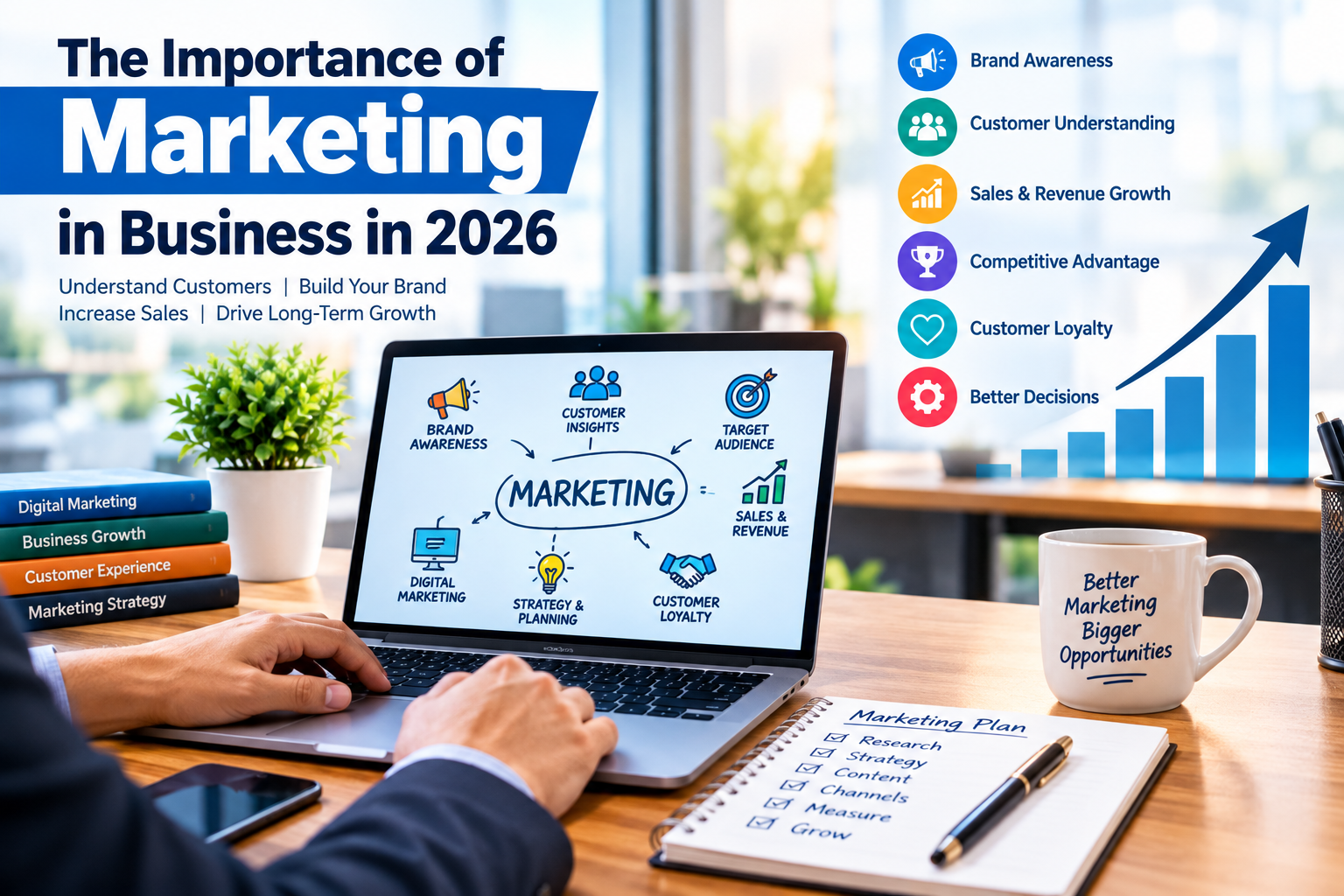
The importance of marketing in business in 2026 goes beyond advertising products or promoting services. Marketing helps businesses understand their customers, communicate their value, build strong relationships, and compete in changing markets. Whether a company operates online, serves a local community, or sells products internationally, marketing plays an important role in connecting its offerings with the people who need them.
Today’s customers have more choices and access to information than ever before. They can compare products, read reviews, research companies, and evaluate prices before making purchasing decisions. Businesses therefore need more than attractive advertisements. They need a clear marketing strategy that explains what they offer, who they serve, and why customers should choose them.
From market research and branding to digital campaigns and customer relationships, effective marketing supports several areas of business performance. This guide explains what marketing means, why it matters in 2026, its main benefits, common strategies, and how businesses can develop and measure an effective marketing plan.
What Is Marketing in Business?
Marketing is the process of understanding customer needs and creating, communicating, delivering, and exchanging products or services that provide value. It involves more than selling. It includes researching the market, developing suitable products, setting prices, selecting distribution channels, promoting offers, and maintaining customer relationships.
The American Marketing Association describes marketing as a set of activities and processes involved in creating, communicating, delivering, and exchanging offerings that have value for customers and society.
In practical terms, marketing helps a business answer four important questions:
- Who are the customers the business wants to serve?
- What problems or needs do those customers have?
- How does the business’s product or service provide value?
- How can the business communicate that value and make the offering available?
For example, a clothing company needs to understand the styles its customers prefer, determine suitable prices, make products available through appropriate stores or online channels, and communicate why its products are worth considering.
These activities work together to create a complete marketing approach.
Why Marketing Is Important in Business in 2026
1. Builds Brand Awareness and Recognition
Customers cannot consider a business if they do not know it exists. Marketing helps companies introduce their names, products, services, and values to potential customers.
Consistent branding, useful content, advertising, social media activity, and customer recommendations can help people recognize a business over time.
For example, a new restaurant might use local advertising, social media photographs, customer reviews, and an accurate online business profile to introduce its services to people in the surrounding area.
Brand awareness does not automatically lead to sales, but it can help a business become familiar to customers when they are ready to make a purchasing decision.
2. Helps Businesses Understand Customer Needs
Successful marketing begins with understanding the people a business wants to reach.
Market research can help companies learn about customer preferences, purchasing habits, expectations, problems, and opinions about competing products. Businesses can gather this information through surveys, interviews, customer feedback, online reviews, and industry research.
For example, a software company may discover that small businesses want an affordable tool that is easy to use. This information can influence the company’s product features, pricing, and promotional messages.
Understanding customer needs helps businesses make more informed decisions instead of relying entirely on assumptions.
To learn more, explore our guide to The Importance of Market Research.
3. Supports Sales and Revenue Growth
Marketing helps potential customers discover products and understand the reasons to consider purchasing them.
Businesses can use advertising, product demonstrations, informative articles, email campaigns, and sales promotions to generate interest and encourage customers to take action.
However, marketing does not guarantee increased revenue. Results depend on several factors, including product quality, pricing, customer demand, competition, and the purchasing experience.
When marketing activities are connected to a clear sales process, businesses can create more opportunities to attract qualified customers and convert interest into purchases.
4. Creates Competitive Advantage
Most businesses operate in markets where customers can choose between several similar products or services. Marketing helps companies explain what makes their offerings different and why those differences matter.
A competitive advantage may come from product quality, customer service, convenient delivery, specialist knowledge, pricing, or a distinctive brand experience.
For example, two businesses may sell similar products, but one may stand out by offering clearer product information, faster customer support, or more convenient ordering options.
A strong marketing strategy communicates these differences to the right audience.
5. Builds Customer Relationships and Loyalty
Marketing is not finished when a customer makes a purchase. Businesses also need to maintain relationships and provide reasons for customers to return.
Email updates, helpful customer support, loyalty programs, product guidance, and social media communication can help companies stay connected with existing customers.
Listening to customer feedback is equally important. It allows businesses to identify problems, improve their services, and understand what customers value.
Strong customer relationships can encourage repeat purchases, recommendations, and long-term loyalty.
6. Supports Better Business Decisions
Marketing research and performance data can help businesses make decisions about products, pricing, promotions, distribution, and customer service.
For example, if customer feedback repeatedly identifies a problem with a product, a company can investigate whether improvements are needed. If a campaign attracts website visitors but produces few inquiries, the business can review its message, audience, or landing page.
Marketing information does not remove every uncertainty, but it gives business owners useful evidence to guide their decisions.
The Main Elements of a Business Marketing Strategy
A marketing strategy should consider several connected elements. One widely used framework is the marketing mix, commonly known as the 4 Ps.
The 4 Ps of Marketing
| Marketing Element | Meaning | Business Example |
|---|---|---|
| Product | The item or service a business offers | A clothing company selling quality clothing |
| Price | The amount customers pay | Setting prices according to costs, demand, and customer expectations |
| Place | Where and how customers access products | Selling through physical stores and online shops |
| Promotion | How a business communicates its offerings | Advertising, email campaigns, and social media |
1. Product
The product is the item or service a business offers to customers. Companies should understand what customers need and ensure their products provide relevant value.
Important considerations include quality, features, design, packaging, reliability, and customer support.
2. Price
Price is the amount customers pay for a product or service. Businesses need to consider production costs, customer expectations, competitor prices, and the value their offering provides.
A suitable pricing approach should support the business’s financial objectives while remaining appropriate for its target market.
3. Place
Place refers to how and where customers can access a product or service.
Distribution options may include physical stores, company websites, online marketplaces, retailers, wholesalers, and delivery services.
Businesses should select channels that make purchasing convenient for their customers.
4. Promotion
Promotion includes the activities a company uses to communicate with potential customers and explain the value of its offerings.
These activities may involve advertising, public relations, social media, email marketing, content marketing, and sales promotions.
The four elements should work together. For example, promoting a product extensively will not solve a problem if its price is unsuitable or customers cannot easily purchase it.
Common Marketing Strategies Businesses Use in 2026
Businesses can choose from several marketing approaches depending on their audiences, objectives, and resources.
Types of Marketing Strategies
| Marketing Type | Main Purpose | Example |
|---|---|---|
| Digital Marketing | Reaching customers through online channels | SEO, websites, and online advertising |
| Content Marketing | Providing useful information to audiences | Blog articles, guides, and videos |
| Social Media Marketing | Building audience engagement | Business posts and product demonstrations |
| Email Marketing | Communicating with subscribers | Newsletters and product updates |
| Traditional Marketing | Reaching audiences through offline channels | Television, radio, and billboards |
Digital Marketing
Digital marketing uses online channels such as websites, search engines, social media, email, and online advertising to reach customers.
It can help companies build online visibility, communicate with audiences, and measure campaign performance.
Explore our guide to Digital Marketing and Its Impact on Modern Business
Content Marketing
Content marketing involves creating useful information that helps customers understand a subject, solve a problem, or evaluate a product.
Examples include articles, guides, videos, product comparisons, tutorials, and case studies.
Useful content can build credibility and help potential customers make informed decisions.
Social Media Marketing
Social media marketing allows businesses to communicate with audiences through platforms such as Facebook, Instagram, LinkedIn, and TikTok.
Companies can share updates, demonstrate products, answer questions, and build relationships. The most suitable platforms depend on where their target customers spend time.
Email Marketing
Email marketing provides a direct way to communicate with people who have agreed to receive business messages.
Companies can use it to share newsletters, product information, service updates, and relevant offers. Messages should be useful, appropriately timed, and easy to unsubscribe from.
Traditional Marketing
Traditional marketing uses channels such as television, radio, newspapers, magazines, posters, and billboards.
These methods may still be useful for businesses targeting local communities or audiences who respond to offline communication.
Some companies combine traditional and digital channels to support their wider marketing objectives. For a closer comparison, read our guide to Traditional Marketing vs. Digital Marketing.
How to Develop an Effective Marketing Plan
A marketing strategy provides direction, while a marketing plan explains the activities a business will carry out.
Businesses can use the following steps to develop a practical plan.
Step 1: Research the Market
Study customer needs, industry conditions, competitors, pricing, and demand. Use reliable research and direct customer feedback where possible.
Step 2: Define the Target Audience
Identify the people or organizations most likely to need the product or service.
Consider factors such as location, interests, purchasing behavior, business type, customer problems, and budget.
A business does not necessarily need to target everyone. Focusing on a suitable audience can make marketing more relevant.
Step 3: Set Clear Marketing Objectives
Decide what the business wants to achieve. Objectives might include increasing brand awareness, generating qualified leads, improving customer retention, or increasing sales.
Make objectives specific and measurable. For example, a company could aim to increase qualified website inquiries by 15% over the next six months, provided that target is realistic for its current position.
Step 4: Choose Suitable Marketing Channels
Select channels based on customer behavior, business objectives, and available resources.
A local service provider might prioritize local search, customer referrals, and community advertising. An online retailer might focus on its website, search visibility, email, and selected social platforms.
Businesses do not need to use every marketing channel at once.
Step 5: Set a Marketing Budget
Estimate the costs of advertising, content production, marketing tools, staff time, and other activities.
A budget helps businesses control spending and decide how resources should be allocated. It should be reviewed as campaign results and business needs change.
Step 6: Implement and Review the Plan
Put the selected activities into action, monitor their performance, and make adjustments when necessary.
A marketing plan should not remain unchanged if customer needs, competition, or business objectives shift.
The U.S. Small Business Administration’s marketing and sales guide provides additional guidance on developing a marketing plan.
For practical ideas that can help smaller companies put these steps into action, read Effective Marketing Strategies for Small Businesses.
How to Measure Marketing Performance
Businesses should evaluate marketing based on results that relate to their objectives rather than relying only on views, likes, or website visits.
Important Marketing Performance Metrics
| Metric | What It Measures | Why It Matters |
|---|---|---|
| Brand Awareness | How familiar the target audience is with a business | Helps evaluate recognition and visibility |
| Website Traffic | The number of visitors and the channels bringing them to a website | Shows audience interest and traffic sources |
| Conversion Rate | The percentage of visitors or leads completing a desired action | Helps assess how effectively marketing generates results |
| Cost per Lead | The amount spent to generate a potential customer | Helps monitor lead-generation costs |
| Customer Acquisition Cost (CAC) | The cost of acquiring a new customer | Helps evaluate the efficiency of customer acquisition |
| Customer Retention Rate | How effectively a business keeps existing customers | Helps assess customer loyalty |
| Return on Investment (ROI) | The financial return compared with the marketing investment | Helps evaluate the financial value of marketing activities |
The most useful metrics depend on the type of business and campaign. For example, a campaign designed to increase awareness may focus on reach, while a campaign designed to generate sales should pay closer attention to conversions and revenue.
Businesses using digital channels can use tools such as Google Analytics to understand customer journeys and important website actions.
Common Marketing Challenges Businesses Should Understand
Although marketing offers important opportunities, businesses may face several challenges.
Increasing Competition
Customers often have many alternatives. Businesses need to communicate their value clearly and provide a reliable customer experience.
Limited Budgets and Resources
Small businesses may not have the money or staff required to manage many campaigns. Prioritizing the most relevant channels can help them use available resources more effectively.
Changing Customer Expectations
Customer preferences and buying habits can change. Businesses need to listen to feedback and review their products, services, and communication.
Measuring Results Accurately
Some marketing activities influence purchasing decisions over time, making it difficult to attribute every sale to one campaign. Companies should use appropriate metrics and avoid treating every interaction as a direct sale.
Maintaining Trust and Responsible Communication
Businesses should provide accurate product information, avoid misleading advertising, respect customer privacy, and handle personal information responsibly. Trust is important for building lasting customer relationships.
Best Practices for Successful Business Marketing
Businesses can strengthen their marketing efforts by following these principles:
- Understand customer needs before choosing promotional activities.
- Communicate a clear and consistent brand message.
- Focus on the value customers receive rather than making exaggerated promises.
- Choose marketing channels that match the target audience.
- Provide accurate and useful information.
- Maintain good customer service before and after a purchase.
- Set a realistic budget and monitor spending.
- Measure results using objectives that matter to the business.
- Use customer feedback to identify opportunities for improvement.
- Review and update the marketing plan as conditions change.
Conclusion
The importance of marketing in business in 2026 lies in its ability to help companies understand customers, communicate value, build brand awareness, and develop lasting relationships. Marketing supports more than promotion; it also influences product decisions, pricing, distribution, customer experience, and business growth.
Successful marketing does not require every business to use every available platform or spend heavily on advertising. It requires a clear understanding of the target audience, a suitable strategy, useful communication, responsible practices, and regular evaluation.
Businesses that treat marketing as an ongoing part of their operations can make better-informed decisions, respond to changing customer needs, and build a stronger position in their markets.



2 Responses