
Introduction
B2B e-commerce has become an important part of how businesses discover suppliers, compare products, request quotes, place orders, manage accounts, and maintain long-term purchasing relationships. As business purchasing becomes increasingly digital, B2B buyers expect faster access to information, transparent processes, flexible purchasing options, and convenient support.
The experience buyers receive from a B2B supplier is also becoming increasingly similar to the digital experience they expect from consumer e-commerce. Buyers want to research products independently, compare alternatives, check availability, request pricing, communicate with suppliers, and complete routine purchases without unnecessary delays.
According to McKinsey’s 2026 Global B2B Pulse Survey, 71% of surveyed B2B companies offer e-commerce, while roughly one-third of revenue among companies that offer e-commerce flows through digital channels. McKinsey also found that B2B buyers use an average of ten channels throughout their purchasing journey and increasingly expect a seamless experience across those channels.
McKinsey — 2026 Global B2B Pulse
For B2B companies, this means e-commerce is no longer simply an additional sales channel. It can become part of a broader operating model that connects digital buying, marketing, sales, customer data, supplier sourcing, procurement, inventory, fulfillment, and supply-chain management.
A strong B2B e-commerce strategy therefore needs to address more than website design. It should consider how customers find information, how they evaluate suppliers, how they purchase products, how internal teams process orders, and how the company manages suppliers and operational risks.
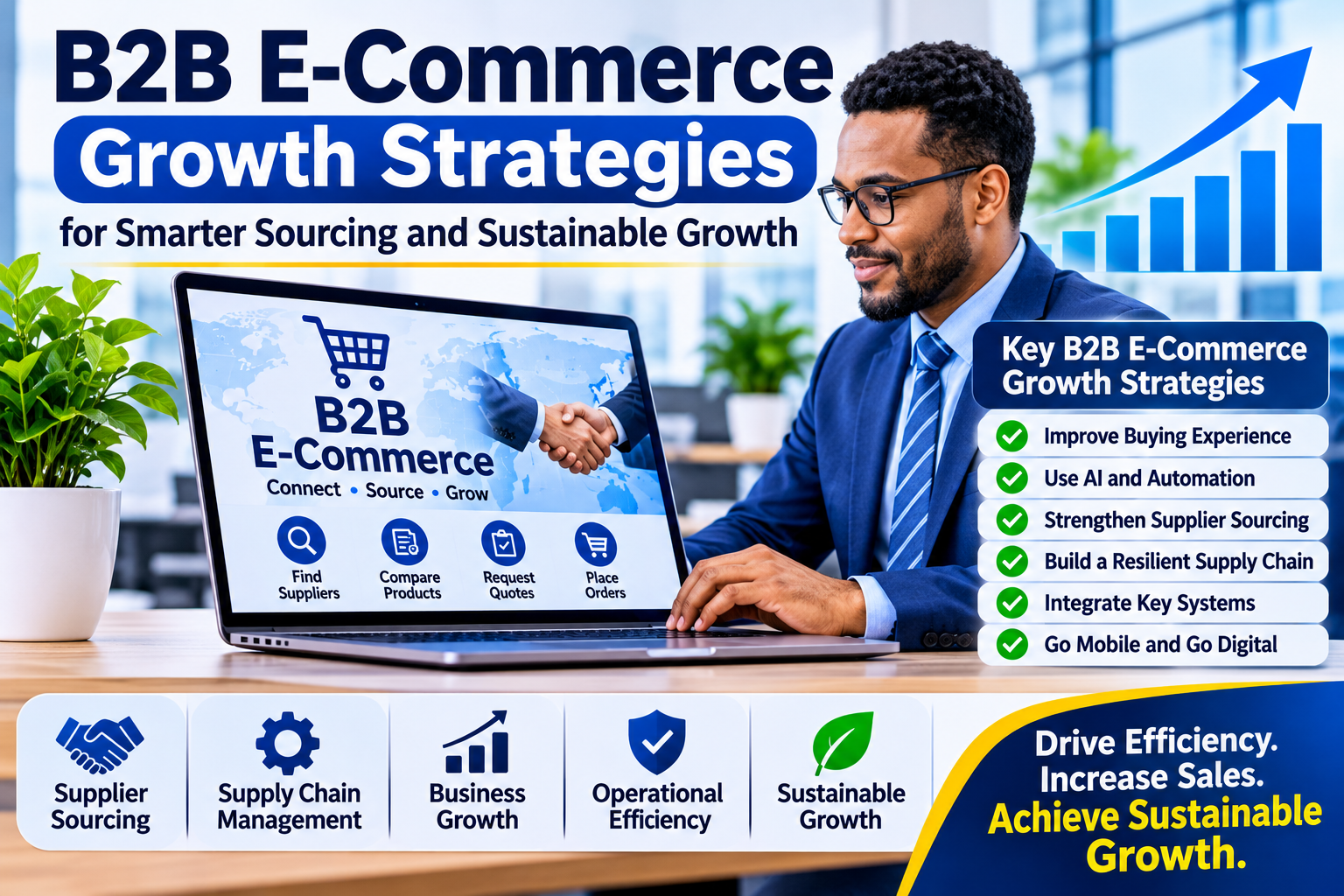
This guide explains practical B2B e-commerce growth strategies that businesses can use to create better buying experiences, improve sourcing, strengthen supplier relationships, use AI and automation responsibly, measure performance, and build a more scalable and resilient operation.
What Is B2B E-Commerce?
B2B e-commerce refers to the buying and selling of products or services between businesses through digital channels. Unlike many consumer e-commerce transactions, B2B purchases may involve larger order volumes, negotiated pricing, multiple decision-makers, purchase approvals, contracts, recurring orders, account-specific catalogs, and more complex payment or fulfillment requirements.
For example, a manufacturer may use a B2B e-commerce platform to purchase raw materials from a supplier, while a retailer may use one to reorder inventory from a distributor. A company may also use a digital procurement platform to compare suppliers, request quotations, approve purchases, and manage recurring orders.
A B2B e-commerce platform can allow customers to:
- Browse products and services
- View product specifications
- Check pricing and availability
- Request quotations
- Compare products or suppliers
- Place and manage orders
- Reorder frequently purchased products
- Track shipments
- Manage multiple users and purchasing permissions
- Access invoices and order history
- Save purchasing preferences
- Communicate with suppliers
- Access product documentation
- Manage account-specific pricing or catalogs
The goal is not simply to move traditional purchasing processes online. A successful B2B e-commerce strategy should make the entire buying journey easier while connecting digital commerce with the company’s wider sales, marketing, procurement, financial, and operational systems.
This distinction is important because a technically advanced e-commerce website cannot compensate for poor product information, unreliable inventory, weak supplier performance, complicated purchasing processes, or slow customer support.
1. Create a Frictionless B2B Buying Experience
One of the most important B2B e-commerce growth strategies is reducing unnecessary friction during the buying process.
Business buyers want clear product information, transparent purchasing steps, reliable availability information, and easy ways to complete transactions. Complicated forms, outdated product information, slow quotation processes, unclear pricing, and difficult account management can make customers look for alternative suppliers.
A frictionless experience does not mean removing every step from a B2B purchase. Some business transactions naturally require approvals, negotiations, technical discussions, or legal review. The goal is to remove unnecessary steps while keeping the controls that the business actually needs.
Businesses should focus on:
- Simple website navigation
- Accurate product descriptions
- Clear technical specifications
- Easy search and filtering
- High-quality product images and documentation
- Fast quotation requests
- Simple account management
- Transparent ordering processes
- Clear delivery information
- Accessible customer support
- Easy reordering
- Mobile-friendly pages
- Clear payment and shipping information
Product information is particularly important in B2B commerce. Buyers may need technical specifications, dimensions, compatibility information, certifications, minimum order quantities, lead times, and documentation before they can make a purchasing decision.
A business should therefore treat product content as part of its sales infrastructure rather than as basic website copy.
2. Build Self-Service Without Removing Human Support
B2B buyers increasingly want to research and purchase independently, but that does not mean sales teams are no longer important.
Gartner’s 2026 research found that 67% of B2B buyers prefer a sales-rep-free experience, while 70% prefer a completely digital, self-service buying experience. At the same time, 69% said they prefer to validate AI-generated insights with sales representatives.
Gartner — B2B Buyer Research 2026
This points to a hybrid model rather than a choice between digital commerce and human sales.
Customers should be able to handle routine activities independently while knowledgeable human assistance remains available when the purchase becomes complex.
For example, customers could independently:
- Compare products
- Review technical specifications
- Download documentation
- Check order status
- View previous purchases
- Request routine quotations
- Reorder products
- Update account information
Sales representatives can then focus more heavily on:
- Complex negotiations
- Customized solutions
- Strategic accounts
- Technical consultations
- Contract discussions
- High-value purchases
- Risk reduction
- Decision validation
This approach can make the customer experience faster without removing the expertise that is often necessary in B2B transactions.
3. Personalize the B2B Customer Experience
B2B customers do not all have the same needs. A small business purchasing office supplies may have very different requirements from a manufacturer purchasing components in large quantities.
B2B e-commerce platforms can use customer information to create more relevant experiences.
Examples include:
- Personalized product recommendations
- Customer-specific pricing
- Previously purchased products
- Reorder suggestions
- Industry-specific product categories
- Relevant educational content
- Customized promotions
- Account-specific catalogs
- Recommended accessories or related products
- Customized purchasing workflows
For example, a manufacturing customer that repeatedly purchases the same components could be shown reorder options, current availability, and related products rather than having to search through the entire catalog every time.
Personalization should be useful rather than intrusive. Businesses should focus on helping customers find relevant products and information more efficiently.
It is also important to distinguish personalization from simply displaying more products. Effective personalization should reduce decision-making effort and make the purchasing process more relevant to the customer’s business context.
4. Use First-Party Data
First-party data can become an important asset for B2B e-commerce businesses.
This may include information such as:
- Products customers frequently purchase
- Search behavior
- Order history
- Quote requests
- Website interactions
- Content engagement
- Customer preferences
- Account activity
- Reorder frequency
- Product interests
When managed responsibly, this information can help businesses understand customer needs and improve marketing, sales, product recommendations, customer service, and account management.
For example, repeated searches for a particular product category may indicate demand that the company should investigate. Frequent abandoned quotation requests could also reveal friction in the purchasing process.
However, businesses should not treat customer data simply as a marketing asset. Data quality, privacy, security, access controls, retention policies, and appropriate use are equally important.
Companies should establish appropriate data governance, access controls, privacy practices, and security procedures. Data should be collected for legitimate business purposes and handled according to applicable privacy requirements.
5. Apply AI and Automation
AI and automation can help B2B companies handle repetitive tasks, analyze information, improve search, and make digital commerce more efficient.
Potential applications include:
- Product recommendations
- Customer-service chatbots
- Automated email responses
- Lead qualification
- Demand forecasting
- Inventory analysis
- Search optimization
- Sales forecasting
- Customer segmentation
- Personalized product suggestions
- Order processing
- Product-content assistance
- Customer-intent analysis
- Internal reporting
However, AI should support business decisions rather than replace human judgment in every situation.
Gartner’s 2026 research found that 45% of surveyed B2B buyers had used GenAI during a recent purchase, primarily to gather information about vendors and products. Gartner also found that buyers still turn to sales representatives to validate AI-generated information and support important decisions.
This makes accuracy particularly important.
Businesses should review AI-generated product information, pricing, recommendations, customer-facing content, and other commercially important outputs before relying on them.
AI can also create risks if it produces outdated, incomplete, or incorrect information. Gartner reported that 51% of surveyed B2B buyers said they were more likely to encounter misleading information from GenAI, demonstrating why human validation and reliable underlying data remain important.
The strongest approach is therefore not “AI instead of people.” It is using AI where it can improve speed and efficiency while keeping appropriate human oversight for high-impact decisions.
6. Strengthen B2B Supplier Sourcing
E-commerce growth depends not only on customers but also on the quality and reliability of suppliers.
A business can have an excellent online storefront but still struggle if suppliers regularly experience stock shortages, quality problems, inconsistent lead times, communication failures, or unexpected price changes.
A stronger sourcing strategy should consider:
- Supplier reliability
- Product quality
- Pricing
- Lead times
- Minimum order quantities
- Geographic location
- Production capacity
- Certifications
- Sustainability practices
- Communication quality
- Risk exposure
- Financial stability
- Business continuity capabilities
Supplier selection should therefore look beyond the lowest purchase price.
A supplier offering a slightly lower price may become more expensive overall if it regularly delivers late, provides inconsistent quality, or creates additional operational work.
Businesses can also classify suppliers according to importance. Critical suppliers that provide essential products or components may require deeper risk assessments and alternative sourcing plans than suppliers providing non-critical items.
For businesses looking to build a more responsible sourcing strategy, our guide on Sustainable Sourcing Trends for B2B Companies provides additional information.
7. Supplier Performance Metrics
Supplier performance should be measured using consistent metrics instead of relying only on price.
| Metric | Why It Matters |
|---|---|
| On-time delivery | Shows supplier reliability |
| Defect rate | Measures product quality |
| Lead time | Helps with inventory planning |
| Cost stability | Supports financial planning |
| Order accuracy | Reduces operational errors |
| Responsiveness | Measures communication quality |
| Capacity | Helps assess scalability |
| Compliance | Reduces operational and regulatory risks |
| Fill rate | Shows how consistently supplier demand is fulfilled |
| Recovery time | Helps assess how quickly problems are resolved |
These metrics should ideally be reviewed over time rather than judged from a single transaction.
For example, a supplier that delivers 98% of orders on time over several months provides stronger evidence of reliability than one successful delivery.
Businesses can also establish supplier performance thresholds. Suppliers that consistently fall below agreed standards may require corrective action, additional monitoring, or replacement.
Tracking these metrics over time can help businesses identify reliable suppliers and address recurring problems before they affect customers.
8. Build a More Resilient Supply Chain
Supply-chain resilience is another important part of B2B e-commerce growth.
Businesses can face disruptions caused by transportation problems, supplier failures, geopolitical events, demand changes, cyber incidents, natural hazards, regulatory changes, or other unexpected circumstances.
A resilient supply chain does not mean eliminating every possible risk. Instead, it means identifying important risks, preparing response options, and improving the organization’s ability to continue operating and recover when disruptions occur.
Businesses can strengthen resilience by:
- Diversifying critical suppliers
- Maintaining appropriate inventory buffers
- Monitoring supplier performance
- Identifying alternative sourcing options
- Improving supply-chain visibility
- Establishing contingency plans
- Regularly reviewing supplier risks
- Mapping critical products and dependencies
- Testing response procedures
For businesses interested in formal security and resilience frameworks, ISO 28000:2022 specifies requirements for a security management system, including aspects relevant to the supply chain. It is applicable to organizations of different types and sizes.
ISO 28000:2022 — Security and Resilience
ISO 28000 should not be presented as a guarantee that a supply chain will never experience disruption. Instead, it provides a structured management-system framework that organizations can consider when managing security-related risks.
9. Connect E-Commerce, CRM, ERP, and Procurement
A B2B e-commerce platform becomes more valuable when it connects with other business systems.
For example, integrating e-commerce with a CRM can help sales teams understand customer activity. Connecting it with an ERP system can improve visibility into inventory, orders, pricing, financial processes, and other operational information.
Useful integrations may include:
- CRM
- ERP
- Inventory management
- Procurement software
- Accounting systems
- Payment systems
- Shipping platforms
- Customer-support systems
- Marketing automation tools
- Business intelligence platforms
Integration can reduce duplicate data entry and improve consistency between departments.
For example, if an order is placed through an e-commerce platform, the relevant information may need to flow into inventory, fulfillment, accounting, and customer-management systems. Without appropriate integration, employees may have to enter the same information manually into several systems.
Businesses should not integrate every system simply because integration is technically possible. The priority should be business processes where better data flow can reduce errors, save time, or improve customer service.
Businesses looking to improve operational efficiency can also explore our guide to Best B2B Supply Chain Automation Tools for Business Efficiency.
10. Create a Practical Digital Transformation Roadmap
B2B e-commerce transformation does not need to happen all at once.
A practical roadmap could begin with the following stages:
Stage 1: Evaluate the current process
Identify where customers experience delays, confusion, or unnecessary manual work. Review the existing customer journey from product discovery to purchase, fulfillment, support, and repeat ordering.
Stage 2: Improve the customer experience
Make product information, navigation, search, quotation, ordering, and account management easier.
Stage 3: Improve product data
Standardize product names, descriptions, specifications, images, documentation, pricing rules, and inventory information.
Stage 4: Connect business systems
Integrate CRM, ERP, inventory, procurement, and e-commerce systems where appropriate.
Stage 5: Introduce automation
Automate repetitive processes such as order notifications, customer segmentation, reporting, routine communication, and selected internal workflows.
Stage 6: Introduce AI carefully
Use AI for appropriate tasks while maintaining human oversight for important commercial decisions.
Stage 7: Measure and improve
Track customer behavior, conversion rates, order values, retention, operational efficiency, supplier performance, and customer satisfaction.
This phased approach can reduce unnecessary disruption and make it easier for organizations to prioritize investments according to business needs rather than adopting technology simply because it is available.
11. Connect B2B E-Commerce With Digital Marketing
B2B e-commerce and digital marketing should work together.
Customers may discover a business through search engines, social media, email campaigns, industry publications, referrals, or other digital channels before visiting the e-commerce platform.
Marketing can support e-commerce by:
- Creating educational content
- Improving organic search visibility
- Building email campaigns
- Supporting lead generation
- Promoting valuable products
- Retargeting qualified audiences
- Building brand authority
- Educating customers about complex products
- Creating comparison and buying guides
- Supporting existing customers with useful content
The connection between marketing and e-commerce is particularly important for products that require research before purchase.
For example, a potential buyer may first discover an educational article, compare several suppliers, download product documentation, request a quotation, and later return to place an order.
For additional guidance, see our article on Best B2B Marketing Strategies to Generate Leads
Businesses should also understand their customers before investing heavily in marketing. Our guide on The Importance of Market Research explains how research can help businesses better understand customers, competitors, and market opportunities.
12. Make B2B E-Commerce Mobile-Friendly
Mobile optimization is important even when customers make large purchases through desktop computers.
A buyer may use a smartphone to:
- Research a product
- Compare suppliers
- Read specifications
- Check order status
- Contact a sales team
- Review pricing
- Reorder a product
- Read an article or buying guide
- Check delivery information
A mobile-friendly B2B website should have readable content, simple navigation, fast-loading pages, accessible forms, and buttons that are easy to use on smaller screens.
However, mobile optimization should not simply mean making a desktop website smaller. Important functions such as search, product comparison, account access, quotation requests, and order tracking should remain easy to use on mobile devices.
Mobile optimization should therefore be part of the overall customer experience rather than treated as a separate feature.
13. Measure B2B E-Commerce Performance
Businesses should measure the performance of their e-commerce strategy using meaningful business metrics.
| KPI | What It Measures |
|---|---|
| Conversion rate | Percentage of visitors who complete a desired action |
| Average order value | Average revenue generated per order |
| Customer retention | Ability to keep existing customers |
| Repeat purchase rate | Frequency of repeat orders |
| Cart abandonment | Customers who begin but do not complete purchases |
| Customer acquisition cost | Cost of acquiring a customer |
| Customer lifetime value | Long-term customer value |
| Quote-to-order rate | Percentage of quotes converted into orders |
| Order accuracy | Accuracy of orders processed |
| Supplier performance | Reliability of suppliers |
| Gross margin | Profitability after direct costs |
| Customer satisfaction | Quality of the customer experience |
The right metrics depend on the company’s business model, sales cycle, purchasing process, and objectives.
For example, a business selling high-value industrial equipment may have a lower website conversion rate but a much higher average order value and longer sales cycle than a company selling frequently reordered office supplies.
Businesses should therefore avoid comparing KPIs without considering their business model.
They should also avoid focusing on website traffic alone when the ultimate goal is profitable growth. Traffic is useful only when it contributes to qualified leads, purchases, repeat business, or other meaningful outcomes.
14. Use Sustainability as Part of the Strategy
Sustainability is increasingly relevant to B2B sourcing and procurement decisions.
Companies can consider:
- Supplier environmental practices
- Packaging requirements
- Transportation efficiency
- Product lifecycle
- Waste reduction
- Responsible sourcing
- Supplier transparency
- Resource efficiency
- Product durability
Sustainability should be connected to measurable business and procurement criteria rather than treated only as a marketing message.
For example, a business could evaluate suppliers based on packaging efficiency, material sourcing, product durability, transportation requirements, and documented environmental practices where these factors are relevant to its procurement goals.
However, sustainability claims should be supported by reliable evidence. Businesses should avoid broad environmental claims that cannot be demonstrated.
A practical approach is to establish measurable sourcing criteria and evaluate suppliers consistently rather than treating sustainability as a marketing message alone.
Practical B2B E-Commerce Growth Framework
A business can organize its strategy around five connected areas:
1. Customer Experience
Make buying simple, fast, transparent, and convenient.
2. Digital Commerce
Provide strong product information, search, ordering, account management, quotation tools, and self-service capabilities.
3. Data and Technology
Connect e-commerce with CRM, ERP, analytics, automation, inventory, procurement, and other relevant systems.
4. Sourcing and Supply Chain
Develop reliable suppliers, monitor performance, identify critical risks, and prepare alternative options where appropriate.
5. Marketing and Sales
Use digital marketing to attract qualified buyers while giving sales teams the information they need to support complex decisions.
When these areas work together, e-commerce becomes more than an online storefront. It becomes part of the company’s broader growth and operating model.
Common B2B E-Commerce Mistakes to Avoid
Businesses can invest heavily in technology and still fail to achieve meaningful results if the underlying customer or operational problems are ignored.
Common mistakes include:
- Building an e-commerce platform without researching customer needs
- Making product information difficult to find
- Ignoring mobile users
- Creating complicated checkout processes
- Failing to integrate important business systems
- Using AI without reviewing its output
- Selecting suppliers based only on price
- Ignoring supply-chain risks
- Measuring traffic instead of business outcomes
- Treating digital commerce as separate from sales and marketing
- Launching too many technologies without a clear business objective
- Failing to maintain accurate product and inventory data
The strongest strategies focus on business outcomes rather than technology alone.
Frequently Asked Questions
What is the most important B2B e-commerce growth strategy?
Improving the customer buying experience is one of the most important starting points. Businesses should make it easy for customers to find information, compare options, request quotes, place orders, and receive support.
However, customer experience should be supported by reliable product data, fulfillment, supplier performance, and internal processes. A smooth website cannot compensate for consistently poor delivery or product quality.
How can AI help B2B e-commerce?
AI can support product recommendations, customer service, forecasting, search, lead qualification, personalization, content assistance, and other repetitive or analytical activities.
However, important customer-facing information should be reviewed for accuracy. AI should be implemented around specific business needs rather than adopted simply because it is a current technology trend.
Should B2B companies offer self-service?
Yes, when appropriate. Many B2B buyers prefer to research and complete routine purchasing activities independently. However, human support remains valuable for complex purchases, negotiations, technical questions, and decision validation.
How can B2B businesses improve supplier performance?
Businesses should establish clear supplier-selection criteria and track metrics such as delivery reliability, quality, lead times, responsiveness, order accuracy, capacity, and cost stability.
Regular performance reviews can help identify recurring problems and determine when corrective action or alternative sourcing may be necessary.
Why is supply-chain resilience important for B2B e-commerce?
Customers expect reliable availability and delivery. Supply-chain disruptions can affect inventory, fulfillment, customer satisfaction, and revenue.
Building alternative sourcing options, monitoring supplier risks, improving visibility, and preparing contingency plans can improve an organization’s ability to respond to disruptions.
What should a B2B e-commerce website include?
A strong B2B e-commerce website should provide clear product information, search and filtering, account management, pricing or quotation tools, ordering capabilities, payment options where appropriate, delivery information, order tracking, and accessible customer support.
The exact features should depend on the company’s products, customers, sales model, and purchasing requirements.
How long does B2B e-commerce transformation take?
There is no universal timeline. Smaller improvements can be implemented relatively quickly, while larger projects involving ERP, CRM, procurement, inventory, and e-commerce integration may require considerably more planning and testing.
A phased roadmap is often more practical than attempting to transform every process at once.
Final Thoughts
B2B e-commerce growth is no longer about simply putting products online. Successful companies need to connect customer experience, digital commerce, marketing, sales, technology, supplier sourcing, procurement, and supply-chain management.
The most effective approach is usually gradual. Start by identifying customer and operational problems, improve the digital buying experience, strengthen product information, connect important systems, strengthen supplier relationships, introduce automation where it adds value, and use AI carefully with appropriate human oversight.
Current B2B research shows that digital self-service and AI-assisted buying are becoming increasingly important, but buyers still value human expertise when they need validation, confidence, and support with important decisions.
As B2B buyers become more comfortable with digital self-service and AI-assisted research, companies that provide accurate information, flexible purchasing options, reliable support, strong supplier relationships, and consistent operational execution will be better positioned to compete.
Ultimately, sustainable B2B e-commerce growth comes from making it easier for customers to buy while making it easier for the business to operate, learn, adapt, manage risk, and scale.



2 Responses