
Introduction
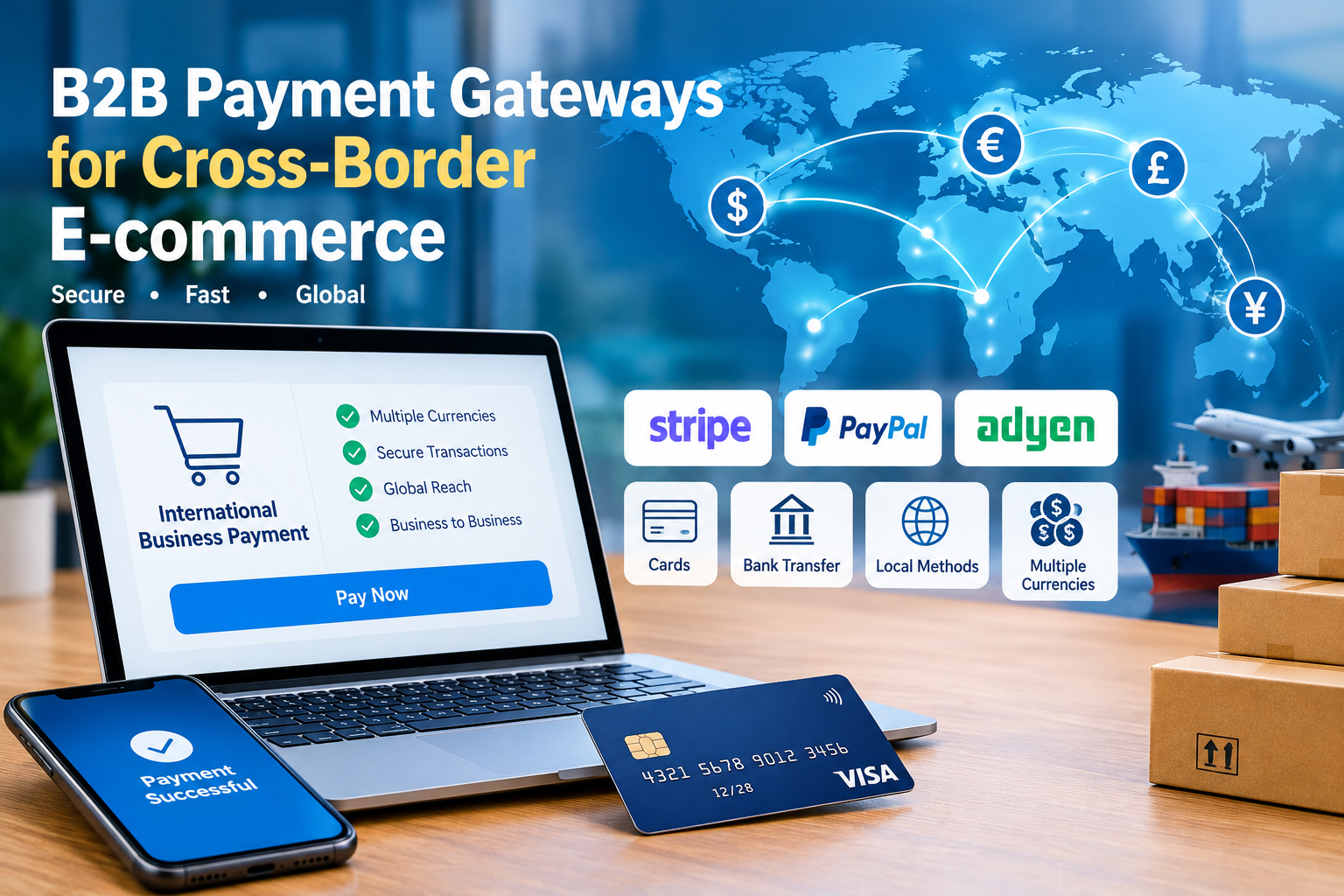
Selling online to customers in different countries can open new opportunities for e-commerce businesses, wholesalers, manufacturers, distributors, and B2B sellers. However, accepting international payments is more complicated than simply adding a credit-card checkout to a website.
Cross-border transactions can involve multiple currencies, payment methods, foreign-exchange costs, fraud risks, chargebacks, settlement requirements, and country-specific rules. Customers in different markets may also prefer different ways to pay, from cards and digital wallets to bank-based payment methods.
International payment gateways help businesses manage these transactions by connecting online stores and business payment systems with payment processors and financial institutions. Depending on the provider and market, they may support card payments, digital wallets, local payment methods, recurring payments, invoicing, and multi-currency processing.
For B2B e-commerce, payment requirements can be even more complex. Businesses may receive larger orders, issue invoices, accept repeat payments, negotiate payment terms, and serve customers across several countries.
This guide compares several important international payment solutions and explains their features, advantages, limitations, and suitability for different types of e-commerce businesses.
What Is an International Payment Gateway?
An international payment gateway is technology that helps an online business securely collect payment information and pass transaction details to the relevant payment-processing and financial systems.
A simplified online card transaction can involve several parties, including the customer, merchant, payment gateway, payment processor, acquiring bank, card network, and issuing bank.
The gateway is therefore only one part of the overall payment infrastructure.
For international e-commerce, a payment solution may also provide:
- Multi-currency payment acceptance.
- Credit and debit card processing.
- Digital wallet support.
- Local payment methods.
- Payment links and online invoices.
- Recurring payments.
- Refund and dispute management.
- Fraud detection and payment authentication.
- Settlement and payout services.
- Integration with e-commerce platforms and business software.
Businesses should also understand that payment availability is not universal. A provider may allow customers in a particular country to make payments while not allowing businesses registered in every country to open merchant accounts.
For example, Stripe states that its business-account availability depends on the country where the business operates, and opening an account in another country can require a legal entity, tax identification, physical location, phone number, and bank account in that country.
For the latest information on Stripe’s global business availability, currencies, and international payment capabilities, see Stripe’s official global business information.
Payment Gateway vs. Payment Method vs. Payment Processor
These terms are often used interchangeably, but they are not exactly the same.
Payment Gateway
A payment gateway handles the technology that securely passes payment information between the merchant’s checkout and the payment-processing infrastructure.
Payment Method
A payment method is the way the customer actually pays.
Examples include:
- Visa or Mastercard.
- American Express.
- PayPal.
- Apple Pay.
- Google Pay.
- Bank transfer.
- Direct debit.
- Local digital wallets.
- Other market-specific payment methods.
Payment Processor
A payment processor helps process the transaction between the merchant, payment networks, banks, and other financial institutions.
Modern payment companies often combine several of these functions into one platform, which is why the terminology can sometimes appear confusing.
Best International Payment Gateways for E-commerce in 2026
There is no single payment gateway that is best for every international business. The right choice depends on the business’s country, target markets, transaction volume, payment methods, technical requirements, and cost structure.
1. Stripe
Stripe is a strong option for online businesses that need flexible payment infrastructure and developer-friendly integrations.
Stripe supports payments in numerous currencies and provides tools for online checkout, payment links, recurring payments, and customized payment experiences. Its global-business offering states that Stripe supports businesses in 46 countries and regions and allows selling to customers in 195+ countries, with support for 135+ currencies, although availability varies by product and market.
Stripe also distinguishes between the currencies a business can use to charge customers and the currencies available for settlement. This distinction is important for international merchants because accepting a currency does not necessarily mean the business can settle or withdraw funds in that same currency.
Key features:
- International card payments.
- Multi-currency payment support.
- Checkout and payment links.
- Recurring payments.
- APIs and developer tools.
- Fraud-prevention features.
- Integration with business applications.
- Support for localized payment experiences in eligible markets.
Best for:
Online businesses, SaaS companies, B2B e-commerce stores, and growing merchants that need flexible payment integrations.
Important consideration:
Before choosing Stripe, confirm that Stripe supports businesses registered in your country and that the specific currencies and payment methods you need are available for your account.
For current Stripe availability, international currencies, and global payment features, see Stripe’s official global payments information.
2. PayPal Business
PayPal Business is another widely recognized option for businesses that want to accept online payments from international customers.
PayPal can be useful when customer familiarity is important because many buyers already recognize the PayPal payment experience.
Businesses can use PayPal for commercial transactions, payment links, invoicing, and other payment services depending on their market and account configuration.
PayPal also supports international payments and multiple currencies. Its business information states that customers can pay in local currencies while merchants can receive funds through supported settlement and withdrawal options. PayPal currently states that businesses can sell in 130+ currencies and receive funds in 24 currencies, although availability and withdrawal rules vary by account and market.
Key features:
- International commercial payments.
- PayPal wallet payments.
- Card payments.
- Payment links.
- Business invoicing.
- Multi-currency capabilities.
- Refund and dispute management.
Best for:
Businesses that want a familiar payment option for international customers and a relatively straightforward online payment experience.
Important consideration:
International transactions and currency conversion can increase the overall cost. PayPal publishes additional international transaction fees on top of applicable domestic commercial transaction charges, so businesses should evaluate the complete fee structure for their market.
For current international payment capabilities and cross-border payment information, see PayPal’s official cross-border payments information.
3. Adyen
Adyen is a global payment platform designed for businesses that need to manage payments across multiple markets.
It supports cards, digital wallets, bank-based payment methods, buy-now-pay-later options, and other local payment methods. Adyen emphasizes using local payment methods to meet the preferences of customers in different markets.
This can be particularly useful for businesses expanding internationally because customers in different countries do not necessarily prefer the same payment method.
For example, a business selling in several European markets may need to support different local payment methods in addition to international card networks.
Key features:
- Global card payments.
- Local payment methods.
- Digital wallets.
- Recurring payments.
- Refunds.
- Chargeback management.
- Multi-market payment infrastructure.
- Online and in-person payment capabilities.
Best for:
Larger businesses and international merchants that need a unified payment infrastructure across several markets.
Important consideration:
Businesses should confirm which payment methods are available for their specific business model, country, currencies, and integration because availability varies by market.
For current information about supported payment methods, see Adyen’s official payment methods page.
4. B2B Bank Transfers and Business Payment Solutions
Bank transfers are not technically the same thing as a payment gateway, but they remain important for international B2B e-commerce.
Large business purchases may involve invoices that are too expensive or impractical to process entirely through card payments.
For example, a wholesaler purchasing $20,000 worth of inventory may prefer an international bank transfer because the transaction is connected to an invoice and business accounting process.
Bank-based payments can therefore complement card-based payment gateways.
Best for:
- Large B2B orders.
- Wholesale transactions.
- Supplier payments.
- High-value invoices.
- Businesses that prefer bank-based settlement.
Before relying heavily on international bank transfers, businesses should compare:
- Transfer fees.
- Exchange-rate costs.
- Processing times.
- Receiving-bank fees.
- Required payment information.
- Currency availability.
- Regulatory requirements.
For many B2B businesses, the best payment strategy may therefore be a combination of card payments, local payment methods, and bank transfers, rather than relying on one method.
5. Local Payment Methods
Selling internationally does not necessarily mean offering only Visa, Mastercard, or PayPal.
Customers in different markets often have different payment preferences. Adyen’s payment-method documentation illustrates the broad range of regional methods available across markets, including bank-based methods, digital wallets, cards, and other localized options.
For example, a business expanding into a new market may discover that a local payment method is more relevant to its customers than another international wallet.
The important principle is not to add every available payment method.
Instead, businesses should research the payment preferences of their target customers and provide the methods most likely to be used.
Best for:
- Businesses expanding into specific international markets.
- E-commerce stores serving regional customers.
- Merchants that want to reduce checkout friction.
- Businesses targeting customers with strong local payment preferences.
For additional information about international and local payment methods, see Adyen’s official payment methods documentation.
International Payment Gateway Comparison
| Payment solution | Main strength | International use | Best suited for |
|---|---|---|---|
| Stripe | Flexible online payment infrastructure | Strong, but business availability varies | Online and B2B e-commerce businesses |
| PayPal Business | Familiar customer payment experience | Broad international reach | Businesses wanting PayPal and online payment options |
| Adyen | Global and local payment methods | Strong multi-market capabilities | Larger international merchants |
| Bank transfers | Useful for high-value B2B payments | Depends on banking corridors and countries | Wholesale and large invoices |
| Local payment methods | Matches regional customer preferences | Market-specific | Businesses entering new countries |
This comparison should not be interpreted as a universal ranking. A payment provider that works well for one business may not be suitable for another because country availability, transaction size, currencies, payment methods, and technical requirements can differ significantly.
Key Features to Look for in an International Payment Gateway
Choosing an international payment gateway requires more than comparing transaction fees.
1. Multi-Currency Support
A gateway should support the currencies your customers actually use.
However, businesses should check three separate questions:
- Can customers pay in the currency?
- Can the merchant settle funds in that currency?
- Can the merchant withdraw or hold that currency?
These capabilities are not necessarily identical.
Stripe, for example, documents separate considerations for presentment and settlement currencies.
2. Supported Countries
Country availability is one of the first things a business should verify.
A provider may accept payments from customers in many countries while restricting merchant account registration to a smaller list of countries.
This distinction is especially important for businesses operating from countries with limited access to international payment services.
Always check the provider’s current official country-availability list before building your payment infrastructure around it.
3. Security and Fraud Prevention
International e-commerce payments need strong security controls because online card transactions can be exposed to unauthorized use and fraud.
Businesses should look for:
- Secure payment processing.
- Authentication tools.
- Fraud monitoring.
- Access controls.
- Tokenization where appropriate.
- Chargeback management.
- Compliance with applicable payment-security requirements.
EMV 3-D Secure (EMV 3DS) is designed to help merchants and card issuers authenticate e-commerce transactions and reduce card-not-present fraud. It can add an additional authentication step when a transaction is considered higher risk.
For the official technical information about 3-D Secure, see EMVCo’s official 3-D Secure information.
4. PCI Security Requirements
Businesses handling card payments should also understand their responsibilities under applicable payment-card security requirements.
PCI DSS provides a baseline of technical and operational requirements designed to protect payment-card data.
Businesses should determine which responsibilities apply to their particular payment architecture rather than assuming that using a third-party payment provider eliminates every security obligation.
For the current PCI DSS standards and official payment-security resources, see PCI Security Standards Council.
5. Payment Method Coverage
International customers may want to pay using:
- Credit cards.
- Debit cards.
- Digital wallets.
- Bank-based payment methods.
- Local wallets.
- Direct debit.
- Other regional payment options.
The right mix depends on the countries where customers live.
Adyen, for example, documents support for a broad range of global and local payment methods, including cards, wallets, online banking, and direct debit options.
6. Transparent Pricing
Payment costs can involve more than a basic transaction fee.
Businesses should examine:
- Domestic processing fees.
- International transaction fees.
- Currency conversion costs.
- Settlement fees.
- Payout fees.
- Refund fees.
- Chargeback fees.
- Monthly or account fees.
- Fees for additional payment methods.
PayPal’s published business pricing, for example, includes additional percentage-based charges for receiving international commercial transactions.
Therefore, businesses should calculate total payment cost, rather than comparing only the headline transaction rate.
For current pricing, businesses should always check the official provider pricing page because fees can change by country, payment method, currency, and account type.
7. E-commerce Integration
The payment solution should integrate with the technology the business already uses.
Depending on the business, this may include:
- Shopify or another e-commerce platform.
- WooCommerce.
- ERP software.
- Accounting software.
- CRM software.
- Subscription systems.
- Order-management software.
- Invoicing systems.
Good integration reduces manual data entry and makes payment reconciliation easier.
8. Settlement and Payout Options
Receiving a payment is not the final step.
Businesses also need to understand how and when funds reach their bank account.
Review:
- Settlement currencies.
- Payout currencies.
- Payout schedules.
- Minimum payout amounts.
- Bank-account requirements.
- Currency conversion rules.
- Regional restrictions.
This is especially important for international businesses because the currency accepted from a customer may not be the same currency in which the merchant receives its final payout.
Benefits of Using International Payment Gateways
1. Easier International Checkout
Customers are more likely to complete purchases when the checkout supports payment methods and currencies they recognize.
A localized payment experience can reduce unnecessary friction during checkout.
2. More Efficient Payment Collection
Digital payment processing can reduce the need for manually confirming individual transactions.
Payment status can be connected to order and accounting systems, allowing businesses to track successful, failed, refunded, or disputed transactions more efficiently.
3. Better Cash Flow Visibility
Businesses can monitor incoming payments, settlement activity, refunds, and outstanding transactions from centralized payment systems.
This can help finance teams understand when money has been collected and when funds are expected to reach business accounts.
4. Support for International Expansion
Payment infrastructure can make it easier to enter additional markets.
However, payment acceptance alone does not guarantee successful international expansion. Businesses also need to consider taxes, shipping, returns, customer support, local regulations, and market-specific purchasing behavior.
5. Reduced Administrative Work
Integrating payment processing with accounting and e-commerce systems can reduce manual reconciliation.
For example, successful payment information can automatically update an order’s payment status instead of requiring an employee to check the payment manually.
Challenges of Cross-Border E-commerce Payments
International payment systems provide important benefits, but they also create additional challenges.
Currency Conversion Costs
When customers pay in one currency and merchants settle in another, currency conversion may affect the final amount received.
Stripe notes that currency conversion and foreign-exchange costs can depend on the transaction, payment method, and settlement configuration.
Payment Failures
A transaction may fail because of insufficient funds, issuer restrictions, authentication requirements, incorrect payment information, or regional restrictions.
Businesses should monitor failed payments and provide customers with appropriate alternative payment options when possible.
Chargebacks and Disputes
Card transactions can be disputed by customers.
Businesses should maintain transaction records, order information, delivery evidence, and customer communications so that legitimate transactions can be properly reviewed when disputes occur.
Country Restrictions
A payment provider’s international customer coverage does not automatically mean that every business can open an account.
Business registration country, banking arrangements, verification requirements, and provider policies can affect eligibility. Stripe explicitly documents these requirements for businesses seeking accounts in another country.
Regulatory Requirements
International payments can involve financial, tax, consumer-protection, sanctions, and data-security requirements.
Businesses expanding into new countries should obtain appropriate legal or financial advice when necessary rather than assuming that a payment provider automatically handles every regulatory responsibility.
How to Choose the Right International Payment Gateway
Before selecting a provider, businesses should work through the following process.
Step 1: Identify Your Target Markets
List the countries where your customers are located.
Do not begin by choosing a payment provider and then attempting to fit your customers around it.
Step 2: Identify Preferred Payment Methods
Research how customers in those markets prefer to pay.
For some markets, cards may be sufficient. Others may require local wallets, bank-based methods, or additional payment options.
Step 3: Calculate Your Average Transaction Value
Payment requirements can change significantly depending on order size.
A business processing $50 consumer purchases may prioritize checkout convenience and conversion.
A B2B wholesaler processing $10,000 or $50,000 invoices may place greater importance on bank transfers, invoice payments, settlement costs, and account controls.
Step 4: Compare Total Costs
Do not compare only the standard transaction fee.
Calculate the expected cost based on your actual sales volume, currencies, refunds, chargebacks, and international transactions.
Step 5: Verify Business Eligibility
Confirm that the provider allows businesses registered in your country to open and maintain an account.
This should happen before integrating the provider into your e-commerce website.
Step 6: Test the Customer Experience
Test the checkout process on different devices and, where possible, in the markets you intend to serve.
Check:
- Payment speed.
- Mobile usability.
- Currency display.
- Payment-method availability.
- Error messages.
- Refund process.
- Failed-payment handling.
Step 7: Review Payouts and Reconciliation
Make sure your finance team understands how payments are settled, converted, recorded, and reconciled with orders and invoices.
For B2B businesses, payment management is also closely connected to order processing, procurement, inventory, and fulfillment. If your business is looking to automate those operational processes, see our guide to Best B2B Supply Chain Automation Tools for Business Efficiency.
Step 8: Plan for Growth
The provider should be able to support your expected transaction volume and future international expansion.
Changing payment infrastructure after entering several markets can be expensive and technically complicated.
Best Payment Strategy for B2B E-commerce
B2B businesses do not necessarily need to choose only one payment method.
A more practical strategy may combine several options.
For example:
Small and medium online orders:
Cards, digital wallets, and local payment methods.
Large wholesale orders:
Bank transfers, invoice payments, or other business-oriented payment methods.
Repeat customers:
Saved payment methods or recurring billing where appropriate.
International customers:
Localized payment methods combined with major international card networks.
This approach gives customers more flexibility while allowing businesses to choose payment methods according to transaction size and market requirements.
Businesses building a broader B2B digital sales operation can also benefit from combining payment infrastructure with an effective e-commerce strategy. See our guide to B2B E-Commerce Strategies for Sustainable Growth
International Payment Gateway Checklist
Before selecting a provider, ask the following questions:
Can businesses registered in my country use the service?
Which countries can my customers pay from?
Which currencies can customers use?
Which currencies can I settle and withdraw?
What are the international transaction fees?
What are the currency-conversion costs?
Are local payment methods available in my target markets?
Does the gateway support refunds?
How are chargebacks handled?
What fraud-prevention tools are available?
Does it support 3-D Secure where appropriate?
Does it integrate with my e-commerce platform?
Does it integrate with accounting or ERP software?
How quickly are funds settled?
What documentation is required for account verification?
What customer support options are available?
Can the platform support my expected growth?
Answering these questions before implementation can prevent expensive payment-system changes later.
Conclusion
International payment gateways play an important role in modern e-commerce by helping businesses accept payments from customers in different countries and manage multiple payment methods and currencies.
Stripe, PayPal Business, and Adyen provide different approaches to international payment processing, while bank transfers and local payment methods remain important for many B2B and cross-border transactions.
The best solution is not necessarily the provider with the largest number of currencies or payment methods. It is the solution that fits your business location, target markets, transaction sizes, customer preferences, security requirements, integration needs, and total payment costs.
Before choosing a provider, verify business eligibility, supported currencies, settlement options, international fees, payment methods, security capabilities, and integration requirements.
Businesses that combine the right payment methods with a well-designed checkout experience can make international purchasing easier for customers while improving payment management and supporting sustainable cross-border growth.
For more information about building a stronger digital B2B sales operation, see our guide to B2B E-Commerce Strategies for Sustainable Growth